
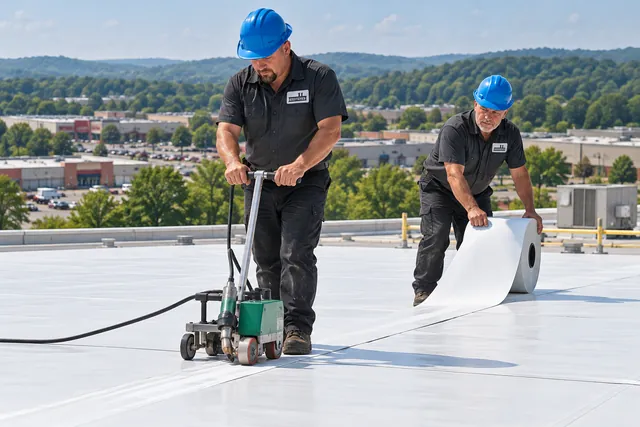
TPO Roofing
Welded white sheet over tapered insulation, the most common replacement on Florence warehouse roofs.
TPO Roofing details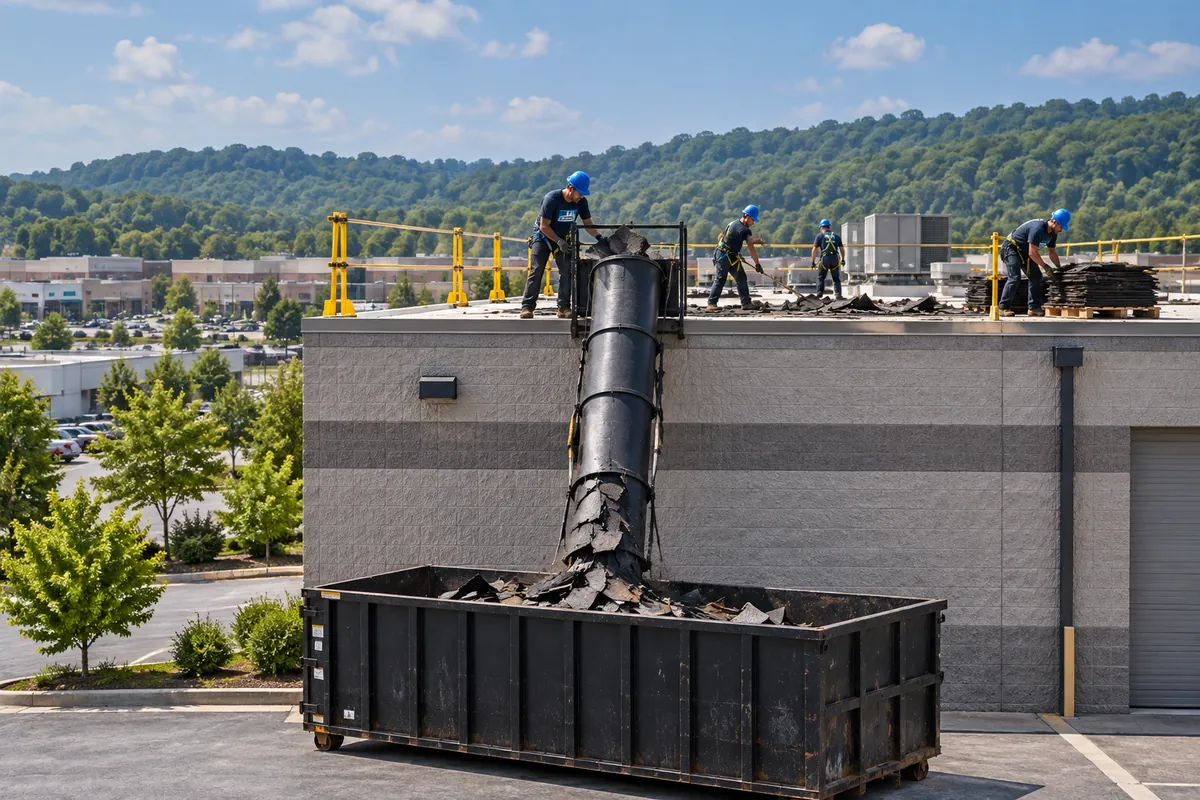
Flat Roofing · Florence, KY
As a Florence flat roofing contractor, we replace and recover low-slope commercial roofs and rebuild the drains, scuppers, and insulation under them.
For any Florence flat roofing contractor, the first fork is recover or tear-off, and the building code sets part of that answer. These are the conditions on each side.
Low-slope roofs fail in a few predictable places. The chip on each condition shows how urgent it is.
Water still sitting days after rain points to a slope problem. Tapered insulation, crickets, or added drains fix what a new membrane alone leaves in place.
A spongy feel when you walk means saturated insulation. Those boards lose R-value, add weight to the deck, and must come out.
Through-wall scuppers left above the roof surface hold a band of water behind the parapet. New scupper boxes set at the finished height let it run.
Bubbles in older asphalt roofs trap moisture between plies. Cut blisters leak, and a field full of them signals the end of that roof.
A thicker new roof leaves old fascia too short. Wood blocking and taller edge metal keep the membrane edge covered and wind-rated.
Snow and ice block drains in winter and back water against laps. Heat-traced drains or overflow scuppers give that water another way off.
A new low-slope roof pays off in three places when the drainage is fixed along with the membrane.
Tapered insulation, sumps at each drain, and overflow scuppers move rain off instead of letting it sit against the laps.
New edge metal set to the finished roof height and fastened to its tested pattern keeps corners from peeling.
Replacing a failed field ends the cycle of patching the same seams after every spring storm.
Removing soaked insulation takes stored water weight off joists that have been carrying it for years.
Recover limits and energy requirements are settled before work starts, so the permit and the scope match.
A tear-off resets the roof to a single new assembly that is easier to inspect, repair, and later replace.
Four membranes cover most low-slope roofs here. Each has its own seam method and best use.
| System | Seams | Surface | Best Use |
|---|---|---|---|
| TPO | Hot-air welded | White | Clean warehouse, retail, and office roofs |
| EPDM | Primer and seam tape | Black or white-on-black | Older masonry buildings and long roofs |
| PVC | Hot-air welded | White | Roofs near grease or chemical exhaust |
| Modified bitumen | Torched or cold-applied laps | Granulated cap sheet | Small additions and roofs with heavy detail work |
High scuppers and slow drains leave water against the wall flashing. Get a free estimate for the drainage fix.
Get A Free EstimateThe order of work on a low-slope tear-off or recover.
A core survey counts the existing layers and finds wet insulation. Drain heights, scupper openings, and edge metal are measured, since a thicker roof changes each one.
A tapered layout is drawn around every drain, with crickets behind curbs and overflow drains or scuppers set just above the primary ones.
For a tear-off, crews strip only the area they can dry in that day and repair the deck. For a recover, wet spots come out and a cover board goes over the old roof.
Insulation, cover board, and the chosen membrane go down in order. Drains get new clamping rings and extensions so they sit at the new surface.
Parapets get new base flashing and coping sloped toward the roof. Edge metal and blocking rise to the finished height, and the final walk checks each drain.
Pick a system for a closer look at how it goes on and where it fits.
Welded white sheet over tapered insulation, the most common replacement on Florence warehouse roofs.
TPO Roofing details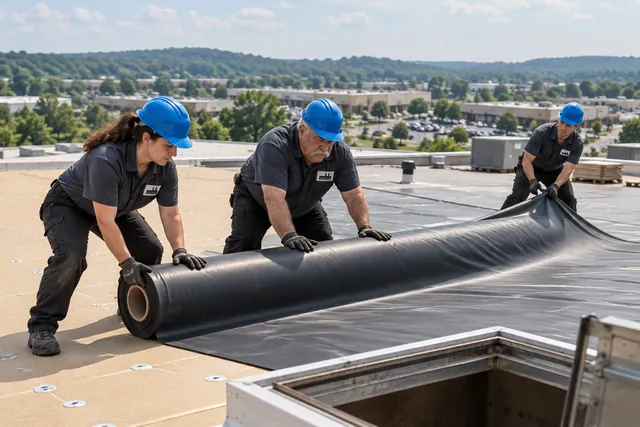
Taped rubber sheets with securement strips at walls, suited to buildings that move with the seasons.
EPDM Roofing details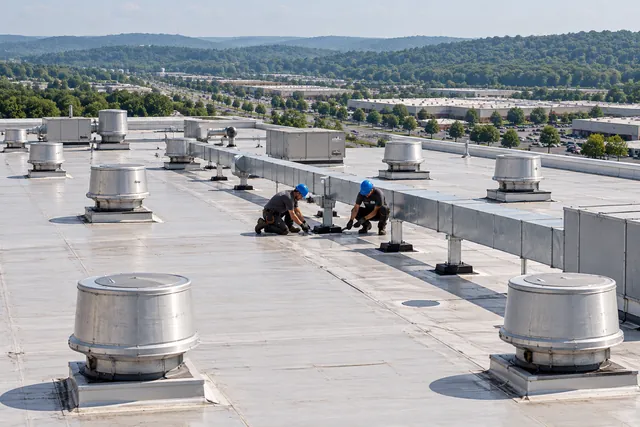
Low-slope plant roofs with exhaust zones, pipe racks, and expansion joints across long runs.
Industrial Roofing detailsAnswers on drainage, layers, and timing for low-slope roof work.
Ponding comes from three sources: clogged drains, low spots where the deck has sagged, and roofs built dead flat with no taper. Clearing strainers fixes the first. The other two need tapered insulation, crickets, or added drains, which go in when the roof is replaced or recovered.
One. Under the building code Kentucky adopts, a recover is ruled out once two or more roofs are in place or the existing roof is water-soaked. A core cut shows how many layers sit on the deck. The Boone County Building Department confirms what applies to a given permit.
Yes, and it happens often. Mod bit and built-up roofs come off to the deck, or stay in place as a recover base if they are dry and single-layer. The new single-ply sheet then goes over insulation and a cover board, with new flashing at every wall and curb.
Drains get new clamping rings, strainers, and extensions so they sit at the new roof level, with a tapered sump around each one. Scupper boxes through parapets are replaced and flashed into the membrane. Overflow drains or scuppers sit a little higher than the main ones so they run only when a drain clogs.
Late spring through fall gives the steadiest weather, since adhesives and sealants need warm surfaces. Mechanically attached TPO handles cooler days better than adhered systems. Morning frost and dew delay starts, and crews open only as much roof as they can seal before rain.
That depends on roof size, tear-off layers, and detail work at curbs and walls, so the inspection sets the schedule. Work runs section by section, with each area sealed before the crew leaves, which keeps the building usable while the roof is replaced.
Tell us the roof size, how many layers you think are on it, and where water sits. We will survey it and price the right low-slope system.