
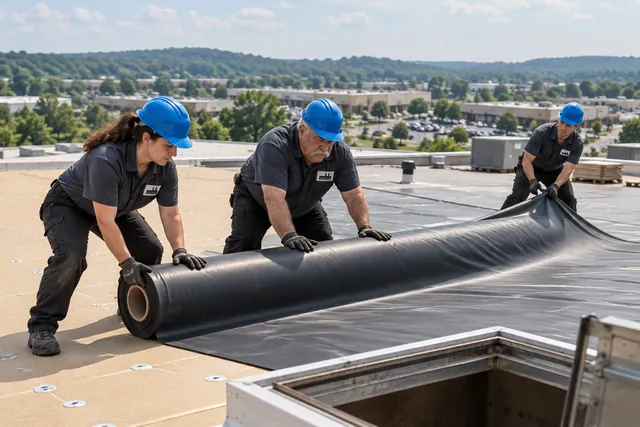
EPDM Roofing
Rubber sheet with taped seams, often picked for older masonry buildings and long roofs that move with the seasons.
EPDM Roofing details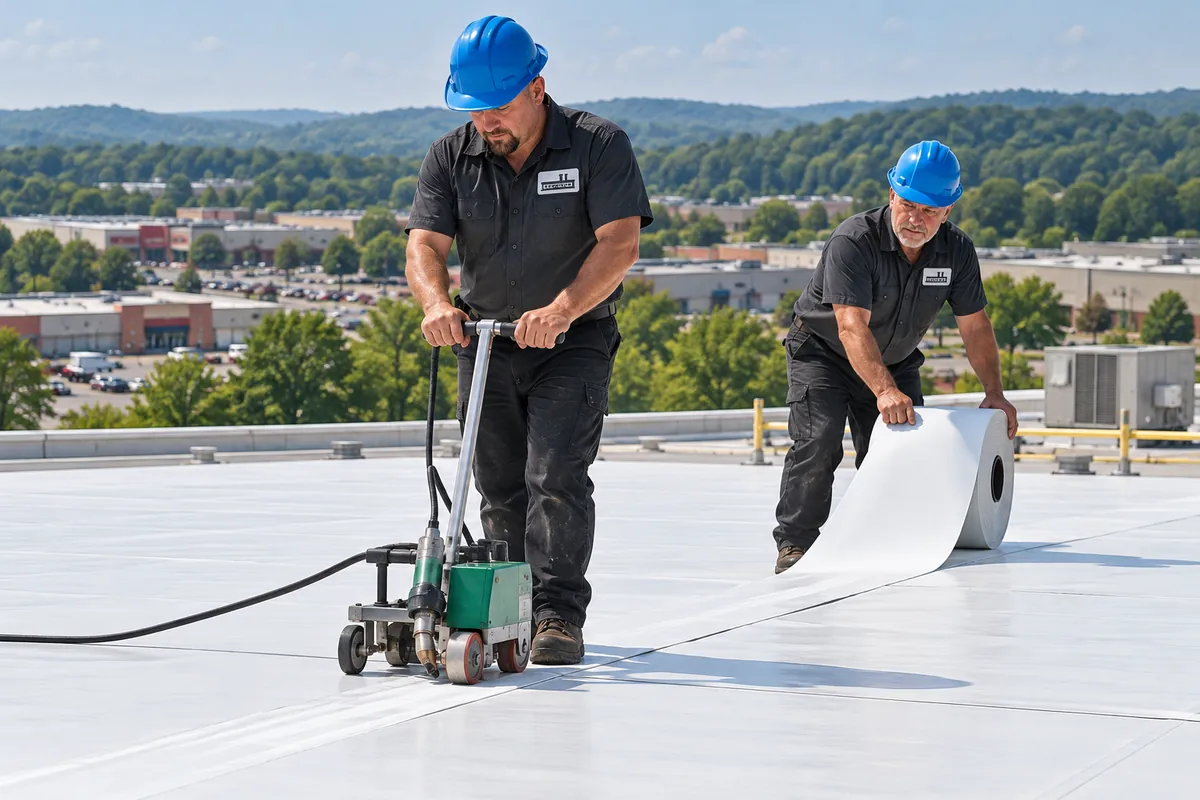
TPO Roofing · Florence, KY
As a Florence TPO roofing contractor, we install white TPO membrane with hot-air welded seams on flat and low-slope warehouse, retail, and office roofs.
Any Florence TPO roofing contractor should check these points before recommending the system. Most flat warehouse and retail roofs pass; a few details send a roof toward PVC or another membrane.
These are the TPO conditions that show up on walks in spring and fall. The chip tells you how soon each one needs a crew.
A probe dragged along each lap catches spots where the weld never fused or wind has opened a wrinkle. Weathered sheet gets cleaned before any reweld will take.
Hand-welded corners and inside patches at rooftop units take the most movement. Hairline splits there let water inside the curb and down the duct chase.
Leaves and grit in strainers back water up across the field. On a flat roof that load builds fast in a storm and tests every seam nearby.
Rings that outline a puddle show where water sits after rain. A tapered insulation fix or a new cricket moves that water to a drain.
Dropped screws, tools, and boot heels near HVAC units leave small holes. Walkway pads along those routes keep the white sheet from being cut.
Bar and counterflashing at the top of parapet flashing can back out in wind and cold. Refastening and resealing them keeps water off the wall side of the sheet.
TPO is chosen for reasons you can see on the roof, feel inside, and track in the budget.
Each lap is heat-fused, so the field, curbs, and parapet flashing become one sheet with no adhesive seams to dry out.
Tapered boards and crickets set under the membrane carry water to drains and scuppers instead of leaving puddles.
The white surface reflects sunlight, so less summer heat soaks through a thin deck into warehouse and office space below.
Hot-air welding needs no open flame or kettle, which suits occupied retail and office buildings.
A replacement can add insulation boards where the energy code requires more R-value under a new roof.
Patches years later are welded TPO to TPO once the weathered surface is cleaned, so repairs stay part of the same sheet.
The way the sheet is held down follows the deck, the wind exposure, and the building height. These are the four methods.
| Method | How The Sheet Is Held | Common Fit |
|---|---|---|
| Mechanically attached | Plates and screws in the seam laps, into the deck | Steel decks on large warehouses |
| Fully adhered | Bonding adhesive across the whole sheet | Windy sites, odd shapes, crowded RTU roofs |
| Induction welded | Plates under the sheet fused by heat from above | Steel decks where a flatter sheet matters |
| Ballasted | Loose sheet held down by stone | Structures rated for the extra weight; rare on TPO |
The manufacturer's tested system and the building code wind design set fastener spacing at corners and the perimeter.
Ponding on a flat roof usually traces to a blocked drain or a low spot in the deck. Ask for a free estimate and a tapered layout.
Get A Free EstimateThe order of work on a TPO installation, from the first roof walk to the last welded corner.
Cores through the old roof show the deck, the insulation, and how many layers are there. Drains, curbs, and parapet heights are measured, since a thicker new roof changes all three.
Soaked boards and a second existing layer rule out a recover. A dry, single-layer roof may take new insulation and TPO over the top, which cuts debris and noise.
Polyiso boards cut to a slight pitch go down in a pattern that steps up away from each drain, with crickets on the high side of curbs. A cover board goes on top to resist punctures.
Sheets roll out over the cover board and are fastened or glued to the tested pattern. A robotic welder fuses each lap, then the crew probes every seam.
Hand welders finish pipe boots, RTU curbs, and inside corners. The membrane turns up parapets to a termination bar or edge metal, and new drain rings clamp the sheet.
TPO is one of three membranes we install on flat roofs. These pages explain the others and when they fit.
Rubber sheet with taped seams, often picked for older masonry buildings and long roofs that move with the seasons.
EPDM Roofing details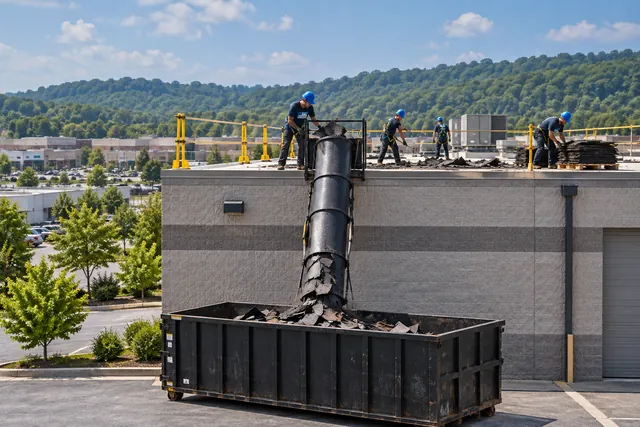
Built-up, mod bit, and PVC options, plus the drainage and recover decisions every low-slope roof starts with.
Flat Roofing details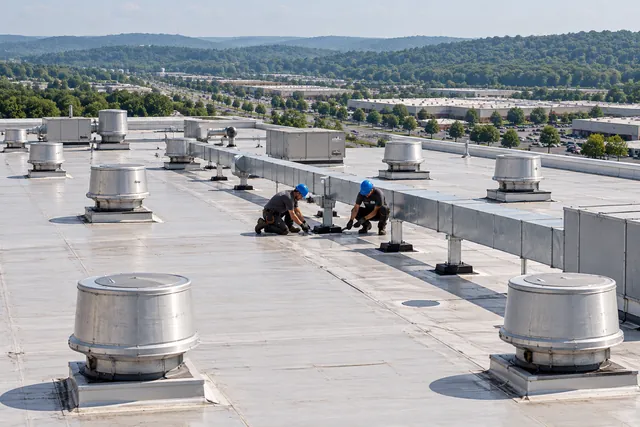
Plant roofs where exhaust, heavy traffic, and expansion joints change which membrane goes where.
Industrial Roofing detailsThe five TPO questions owners ask most, answered for buildings in Florence.
TPO is a white thermoplastic single-ply membrane rolled out in wide sheets over insulation and a cover board on flat and low-slope roofs. Sheets overlap, and a robotic welder fuses each lap with hot air. Hand welders finish corners, pipe boots, and RTU curbs, so the finished roof is one welded surface ending at a termination bar or edge metal.
All three are single-ply membranes. TPO and PVC have hot-air welded seams and come white; EPDM is black rubber with taped seams. PVC stands up best to grease and oil, and EPDM holds up poorly near oils. On a clean Florence warehouse roof with few exhaust fans, TPO is a common pick, with PVC around restaurant or process exhaust.
The deck, the wind exposure, and the building height decide. Mechanically attached TPO suits steel decks on large warehouses. Fully adhered sheets suit windy sites, odd roof shapes, and roofs crowded with units. Induction welding gives a flatter sheet on steel decks. Ballast is rare on TPO and needs a structure rated for the stone.
It builds slope into a flat roof so water runs to drains and scuppers instead of ponding. The boards are cut at a slight pitch and laid to step up away from each drain, with crickets steering water around curbs. It also adds R-value, and a cover board on top protects the white sheet from foot traffic.
Seams, curb and wall flashing, and the membrane around drains. A walk in spring and fall should probe welds for open spots, clear drain baskets and scupper boxes, look for punctures along service paths, check termination bar on parapets, and note dirt rings from ponding. Dated photos after each storm build a record for the building file.
Send the roof size, the deck type if you know it, and any leak spots. We will inspect the roof and price a TPO system that fits.